 RV Roadie
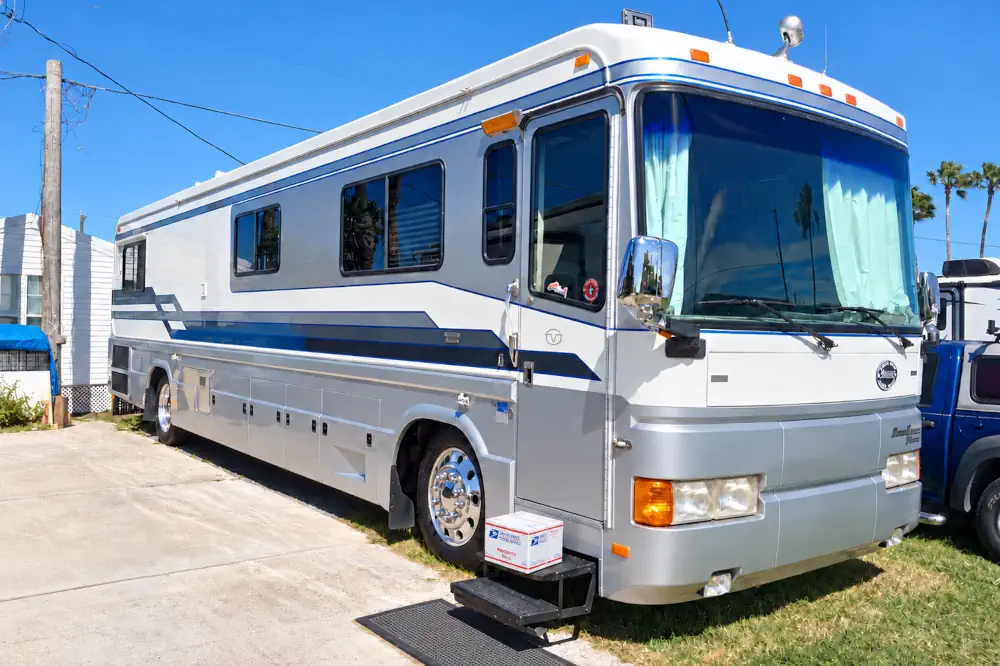
When you sell your house and move into an RV, one of the first real-world questions that pops up isn’t about tanks or campgrounds. It’s this: where does the mail go? Bank statements, insurance cards, a new debit card, the occasional letter from the government that absolutely has to be answered. All of it needs somewhere to land, and “whatever campground we’re at this month” isn’t an address anybody accepts for long.
Here’s the short answer. Most full-time RVers get their mail through a virtual mailbox or mail forwarding service. The service gives you a real street address in the state you call home, receives your mail there, and lets you see what came in online. From there, you decide what happens to each piece: open and scan it, forward it to wherever you’re parked, shred it, or toss it. Packages are a different story, and we’ll get to those.
Bob and I have handled our mail this way for about six years now, using Anytime Mailbox which gives you a virtual mailbox in almost any state. Below is exactly how it works for us, what it really costs, how we handle packages, and how we made Texas our legal home. If you’re still in the planning stage, our beginner’s guide to full-time RV living covers the bigger picture. This post is the mail-and-residency deep dive we promised there.
How Do Full-Time RVers Get Mail?
There are a few common ways full-timers keep a permanent address while living on the road, and they all solve the same problem a little differently.
A virtual mailbox service. Companies like Anytime Mailbox and iPostal1 give you a street address at a mail center, receive your mail, and let you manage it from an online dashboard. You choose what gets scanned, forwarded, shredded, or recycled. This is what we use.
An RV club mail service. Escapees, the RV club, runs a mail service built specifically for full-timers, with addresses in Texas, South Dakota, and Florida. A big part of their appeal is the help and information they offer on setting up residency, which is useful even if you end up going with a different mail service, like we did.
A family member’s or friend’s address. This works for some people, especially early on. Just know you’re asking someone to sort your mail indefinitely, and your legal home ends up being wherever they live, which may not be the state you’d choose.
Whichever route you take, the address you pick usually becomes the address on your driver’s license, vehicle registration, and voter registration. So choose it with your home state in mind. More on that below.
Our Mail Service: Anytime Mailbox, Six Years In
When we went looking for a mail service, Anytime Mailbox had the best offers and pricing we could find. I can’t promise that’s still true today, but in six years we haven’t had a single reason to switch.
One thing that confused me at first: Anytime Mailbox isn’t actually the business holding your mail. It’s the software platform. The mail itself is handled by an independent mail center in the city you pick, and that location runs your mailbox day to day. Ours is 1 Stop Mailbox in Texas, and I log in through their own branded page, not the main Anytime Mailbox site. If you sign up and get bounced to a site with a different name, that’s why. It’s all the same system.
The part I love is that I can log in from wherever we’re parked and see what’s come in. (Our Starlink Mini makes that easy, even when we’re well off the beaten path.) Then I pick what happens to each piece:
- Open and scan. If I want to read it, they open the envelope and scan the contents so I can see it online. If I need a hard copy, I just print the scan myself, which usually saves us from paying to forward the original.
- Forward. If I need the actual paper in my hand, they ship it to wherever we are.
- Shred. For anything with personal info we don’t need.
- Recycle. For the junk mail, which is most of it, honestly.
That’s really the whole routine. Check the dashboard, make a few clicks, and get on with your day.
What RV Mail Forwarding Actually Costs Us
Anytime Mailbox plans are set by each mail center, so prices and features vary from one location to the next. We’re on the Silver plan at our Texas location. Here’s what it includes:
| Silver plan (our location) | What we get |
|---|---|
| Listed price | $14.99 a month ($164.99 a year) |
| Incoming mail | Up to 60 pieces a month |
| Open and scan | 10 requests a month |
| Recycling | Unlimited |
| Shredding | 15 cents per shred |
| Storage | Free for up to 30 days |
| Forwarding | $5 per shipping bundle |
Plan prices are what our location listed in October 2026, and they can change. Recycling, shredding, and storage terms are what our plan includes.
Now for the honest part. That $14.99 isn’t what we actually spend. Some months we go over our 10 scan requests, and anytime we have mail forwarded, there’s a fee. Averaged out, our mail service runs us about $20 - $30 a month. It’s one of those small line items that’s easy to underestimate, so if you’re building a full-time budget, plan on more than the sticker price. (Our post on affordable RV living has more on keeping the monthly numbers realistic.)
If you decide to try Anytime Mailbox, sign up through our referral link and you’ll get a $10 Amazon gift card once you sign up and pay. Full disclosure: we get one too.
Getting Mail and Packages Wherever You’re Parked
Letters are easy. Packages are where full-timers have to get a little creative.
You can have packages sent to your virtual mailbox, and sometimes that makes sense. But then every one of them has to be forwarded to wherever you are, and those forwarding fees add up fast. So for anything we order, we skip the mailbox entirely and have it shipped straight to wherever we’re staying at the time. It’s cheaper, it’s faster, and it means one less thing sitting in Edinburg waiting on us.
There are a couple of other options worth knowing about, especially if you move around more than we do.
General Delivery at the local post office. If you’re on the move a lot, the post office in whatever town you’re staying in can hold mail for you through General Delivery. Have it addressed to your name, the words “General Delivery,” and that post office’s city, state, and ZIP Code, then pick it up at the counter with your ID. A few things to know before you rely on it. USPS holds each piece for no more than 30 days, and General Delivery is meant as a temporary option for people passing through, so if you’ll be in one place longer than a month or so, a PO box is the better fit. In bigger towns, only one post office location may handle General Delivery, so call ahead and ask which one, and which ZIP Code to use, before you have anything sent.
Your campground. Some campgrounds will accept letters and packages for guests, and some won’t. Ask at check-in, or better yet before you order anything, so your package doesn’t end up going back to the sender.
Why We Chose Texas as Our RV Domicile
Your domicile is the state you’re legally a resident of. It’s where your driver’s license, vehicle registration, insurance, voting, and taxes all point back to. When you live in an RV, you get to choose it, and for us Texas was pretty much a no-brainer.
Our friends and family are up north in Wisconsin, and we still spend time there. But we winter in Texas, and when we added it up, we were spending more of the year in Texas than we were in Wisconsin. We’ve also found better doctor options in Texas than we had up north.
Then there’s the money. Wisconsin has a state income tax. Texas doesn’t. Why pay income tax to a state you don’t spend much time in? Once we looked at it that way, the decision pretty much made itself.
As for Edinburg specifically, that one was simple. We were wintering near South Padre Island at the time (here’s where we stayed near South Padre), and Edinburg was the closest place we could set up our mailbox.
How to Establish Texas Residency as a Full-Time RVer
We didn’t make the switch right away. For our first year or so on the road, we were still Wisconsin residents, and our Anytime Mailbox was at a Wisconsin location. We were newbies, still figuring things out. In 2022 we decided to make Texas official, and the first thing we did was move our mailbox to a Texas location, because Texas wants to see a Texas address.
I’ll be honest: the process wasn’t hard, but it can be a little stressful. There’s paperwork, and the steps have to happen in a certain order. I found my answers by searching online, and there’s a lot of good information out there, including the residency guides from Escapees. We did everything in person down in the Rio Grande Valley.
Here’s the order the Texas Department of Motor Vehicles lays out in its checklist for new Texans:
- Get your Texas address. For us, that was the new Edinburg mailbox.
- Get Texas vehicle insurance. You’ll need proof of it for the next steps.
- Get any required inspection. When we did this in 2022, Texas still required a safety inspection before registration. That ended for non-commercial vehicles on January 1, 2025. Now only emissions testing is required, and only in certain counties. Hidalgo and Cameron counties aren’t on that list.
- Title and register your vehicles in person at the county tax office. TxDMV says to do this within 30 days of becoming a resident.
- Get your Texas driver’s license at a Texas Department of Public Safety office. If you’re turning in a valid out-of-state license, DPS waives its usual 30-day residency requirement.
- Register to vote in your new county.
Our Edinburg address is on our driver’s licenses and vehicle registrations. It’s the only address we have, and DPS and the county had no problem with it. Rules can change, though, so check the current requirements with DPS and your county tax office before you go.
Once it’s done, it’s done. We haven’t had to think about it since.
Voting From the Road
Being on the road doesn’t mean giving up your vote. Bob and I are registered in Hidalgo County using our virtual mailbox address, and we vote by mail. In fact, we just mailed in our ballots.
In Texas, one of the reasons you can vote by mail is that you’ll be out of your county during early voting and on Election Day. For most full-timers, that’s just a normal Tuesday.
You have to apply for a mail ballot, and you tell the county where to send it. A couple of things to keep in mind. Your registration takes effect 30 days after the county receives it, so don’t leave it until right before an election. And allow plenty of time for mail. Your ballot has to get from the county to wherever you’re parked and back again, and it’s not as quick as walking down the street to your polling place.
If you’re not sure where you stand, your county elections office can tell you whether you’re registered and what deadlines are coming up.
The One Time Our Virtual Address Was a Problem
In all the years we’ve used a virtual mailbox, we’ve only run into trouble with it once, and it wasn’t with the state. It was a loan.
I was applying for a loan, and the lender wanted an address. When I gave them ours, they wouldn’t accept it because it’s a virtual mailbox address. Their reasoning was “flight risk.” In other words, if your address is a mail center and you live on wheels, a lender gets a little nervous about being able to find you. It’s not something we’d ever thought about until it happened.
That’s been the only time in six years. Our licenses, registrations, insurance, voter registration, and everyday bills all work just fine with our mailbox address. But if you’re planning a big purchase that needs financing after you hit the road, know that some lenders may push back on a virtual address. It’s worth asking about up front, before you’re halfway through an application.
Our Tips for New Full-Timers
Decide on your home state early. We waited about a year, and it worked out fine, but it meant switching our mailbox to a new location partway in. If you already know where you’ll spend most of your time, start there.
Pick a mail center in the state you want as home. Since your mailbox address usually ends up on your license and registration, it needs to be in your domicile state.
Ship packages to where you’re staying. Forwarding packages through your mailbox gets expensive. Ship directly when you can, and ask the campground first.
Go paperless wherever you can. This one really, really helps. Set up as many accounts as you can online and opt in to get notices, statements, and mailings by email instead of on paper. Every piece that never gets mailed is one less thing to scan, forward, or pay for, and it keeps you comfortably under your plan’s monthly limits.
Print your scans. If you just need a hard copy of a letter, print the scan yourself instead of paying to forward the original.
Budget for more than the plan price. Extra scans and forwarding fees can easily double the sticker price. Ours did.
You can’t just file a change of address with the post office. This one surprises people. If you ever leave your mail service, the usual USPS change-of-address form won’t work, because the Postal Service doesn’t forward mail from commercial mail receiving agencies (the official name for private mailbox services like ours). In USPS’s own words, “Mail can be forwarded to a CMRA, but not from a CMRA.” Your mail center is required to keep forwarding your mail for six months after you close your box, but that forwarding can cost you, and six months goes fast. The real fix is to contact every bank, insurer, agency, and subscription that sends you mail and update your address with each one. So pick your mail service carefully up front. Switching later is a project.
Frequently Asked Questions
How do full-time RVers get mail?
Most full-time RVers use a virtual mailbox or mail forwarding service. It gives you a real street address in your home state, receives your mail, and lets you view it online and choose to have it scanned, forwarded, shredded, or recycled. We’ve used Anytime Mailbox for about six years.
Can I use a virtual mailbox address on my Texas driver’s license?
It worked for us. Our Edinburg mailbox address is on our Texas driver’s licenses and vehicle registrations, and we’ve never had a problem with it. Requirements can change, so confirm with Texas DPS before you apply.
Does Texas have a state income tax?
No. Texas doesn’t have a state income tax, which was one of the big reasons we chose it over Wisconsin.
How do full-time RVers get packages?
We have packages shipped directly to wherever we’re staying, after checking that the campground accepts them. You can also send packages to your virtual mailbox, but forwarding fees add up. Some travelers use USPS General Delivery at a local post office, which holds each piece for up to 30 days.
How much does mail forwarding cost for full-time RVers?
It depends on the service and the location. Our Anytime Mailbox Silver plan is listed at $14.99 a month, but with extra scans and forwarding fees, we average about $30 a month.
Can full-time RVers vote by mail in Texas?
Yes, if you qualify. In Texas, being out of your county during early voting and on Election Day is one of the reasons you can vote by mail. We’re registered in Hidalgo County and vote by mail from the road.
Can I file a USPS change of address from a virtual mailbox?
No. USPS doesn’t forward mail from commercial mail receiving agencies, so you’ll need to update your address directly with everyone who sends you mail. The mail center is required to forward your mail for six months after you close your box, but it may charge for that.
The Bottom Line
Getting your mail sorted out as a full-time RVer sounds like a big, scary job, but it really comes down to two decisions: which state you’ll call home, and which mail service you’ll use there. Make those two calls, take the residency steps in order, go paperless wherever you can, and the rest pretty much runs itself.
For us, that’s been Texas and Anytime Mailbox for years now, and other than one nervous loan officer, it’s been smooth sailing. These days, checking the mail means a few minutes online wherever we happen to be parked, which beats walking to the end of a driveway any day. If you’re still working through the rest of the big decisions, head back to our beginner’s guide to full-time RV living for the full checklist.